

An Enterprise Blueprint for Moving Beyond Chatbots to Autonomous Digital Workforces
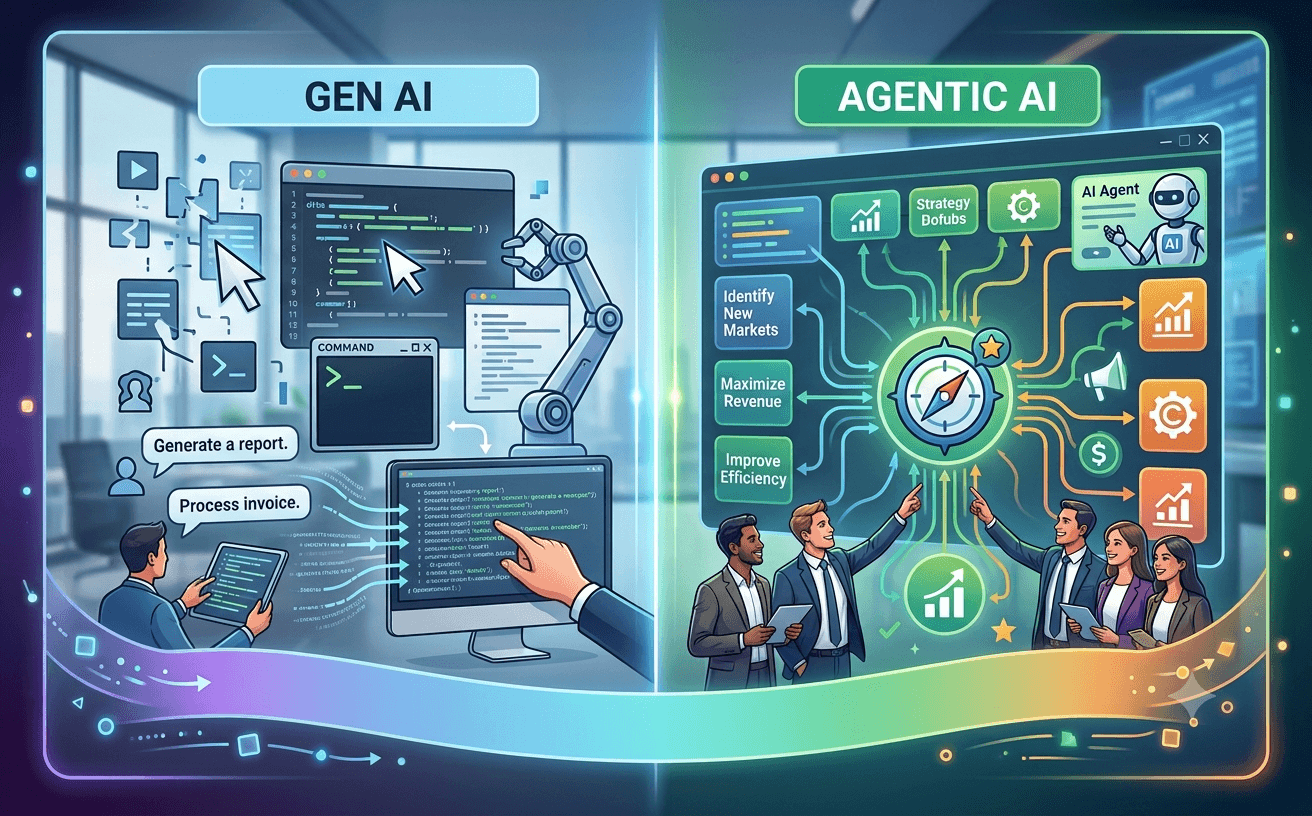
Over the past few years, the corporate world has undergone a massive experiment with Generative AI. Enterprises have deployed conversational chatbots, optimized writing processes, and armed employees with smart copywriters. This phase can be described as the Prompt-Driven Era. In this environment, value is realized linearly: a human sits at a keyboard, formulates a precise prompt, waits for an LLM inference, reviews the output, and copies it into another system to take action.
While this has unlocked historic gains in individual productivity, it has also exposed a core bottleneck: human latency. Generative AI tools are fundamentally reactive. They do not know what to do next until a human presses “Enter.”
A fundamental shift is now occurring as we transition into the Goal-Driven Era, powered by Agentic AI. Business strategy is moving from providing workers with smart assistants to deploying autonomous digital workforces. Instead of micromanaging AI with granular prompts, leaders can now assign high-level business outcomes—such as “Reduce vendor onboarding time by 40% while maintaining compliance”— and allow autonomous agentic pipelines to plan, orchestrate, tool-call, and self-correct until the goal is achieved.
The Core Paradox of Gen AI: Giving every employee a co-pilot makes them faster writers and thinkers, but it doesn’t change the underlying architecture of business workflows. True structural scale requires systems that can execute end-to-end loops autonomously.
1. Understanding the Paradigm Shift
To lead an organization through this transition, it is essential to establish clear definitions for these two operational methodologies:
Prompt-Driven Systems (Generative AI): These are point-in-time, single-inference configurations. The user provides context and constraints, and the system predicts the most statistically probable sequence of tokens to return. The system maintains no persistent state, cannot access external operational tools on its own initiative, and possesses no loop mechanisms to check if its output is correct or useful.
Goal-Driven Systems (Agentic AI): These are persistent, multi-loop architectural frameworks. Instead of a linear script, the agent is given a target objective, a set of environmental guardrails, and an inventory of APIs, databases, and communication channels. The system creates an internal multi-step plan, executes the first step, evaluates the result, and dynamically adapts its subsequent path based on realtime feedback.
2. Anatomy of an Agentic Workflow
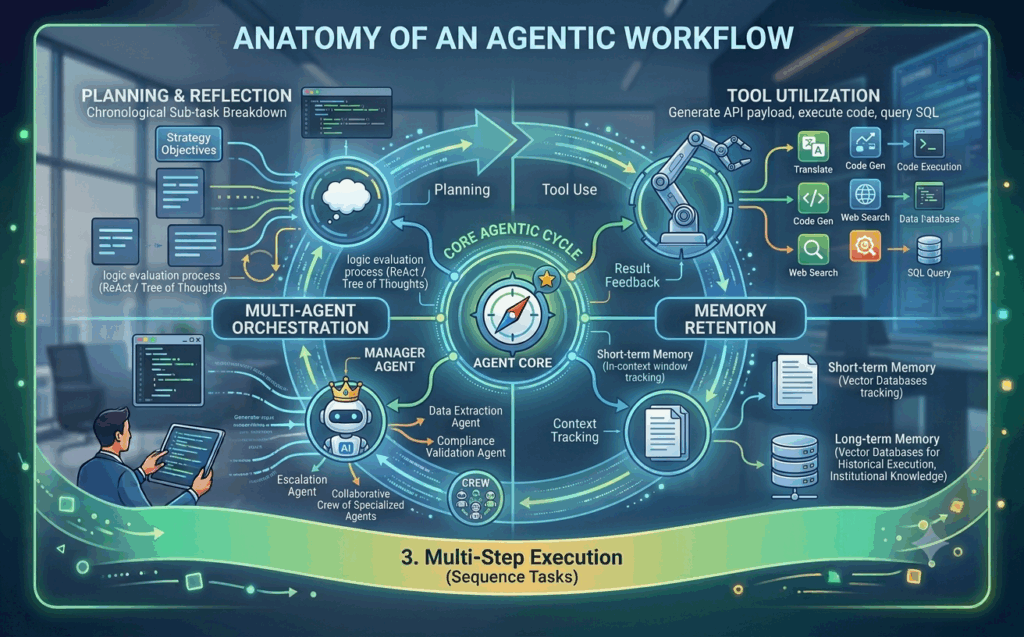
How does an agentic system transform an abstract objective into concrete execution? Unlike a standard LLM call, an agentic framework consists of four core technical pillars:
Planning & Reflection: The agent breaks down a complex goal into smaller, chronological sub-tasks. Advanced frameworks use techniques like Reasoning and Acting (ReAct) or Tree of Thoughts to evaluate their own intermediate logic before taking action.
Memory Retention: Agents utilize short-term memory (in-context window tracking during a multi-turn run) and long-term memory (vector databases storing historical executions and institutional knowledge bases) to maintain continuity across long-running tasks.
Tool Utilization: This is the defining feature of Agentic AI. Agents are exposed to a registry of tools. They can generate an API payload, execute code in a secure sandbox, query a SQL data warehouse, or read an internal document to collect the information they need.
Multi-Agent Orchestration: Complex processes rarely rely on a single agent. Enterprises deploy specialized “crews” or clusters. For example, an invoice processing workflow might feature a Data Extraction Agent, a Compliance Validation Agent, and an Escalation Agent working collaboratively under a manager agent.
3. Redefining Corporate ROI Metrics
Evaluating a goal-driven strategy using prompt-driven metrics can distort investment decisions. Early Generative AI initiatives measured success through volume and speed metrics: words written per minute, code snippets generated, or support tickets drafted. However, maximizing the volume of drafts can sometimes create more review work for human staff.
In the Agentic Era, corporate KPIs must shift toward Autonomy and Task Completion Rates:
Straight-Through Processing (STP) Rate
The percentage of operational workflows handled from initiation to final resolution by the agentic system without requiring a human employee to step in and fix an error. A high STP rate indicates that the agent’s goal-seeking and self-correction loops are operating effectively within defined guardrails.
Cost per Goal Completion vs. Cost per Token
Prompt-driven models are priced by raw context utilization (input/output tokens). Agentic AI calculations focus on the total computing cost required to complete a complex objective. While an agent may run multiple internal thinking loops and consume more tokens than a single prompt, the total cost is evaluated against the manual labor or software costs saved by automating the entire end-to-end workflow.
4. Blueprint for Structural Transformation
Transitioning from a prompt-driven organization to an agentic enterprise requires strategic adjustments to business operations, technical architecture, and risk management.
A. Re-mapping Workflows from Tasks to Outcomes
Operational leaders should review their standard operating procedures (SOPs). Instead of defining rigid, step-by-step human instructions, focus on defining clear inputs, target states, and compliance rules. If an SOP reads like an algorithmic flow chart, it is a strong candidate for an agentic orchestration layer.
B. Transitioning from Prompt Engineers to Agent Architects
The role of “prompt engineering” is rapidly evolving. The next generation of internal AI talent will focus on system design and orchestration. These teams will design multi-agent communication networks, optimize routing logic, manage vector memory structures, and build secure API bridges that connect LLMs to legacy software infrastructure.
C. Shifting Governance from “Human-in-the-Loop” to “Human-on-the-Loop”
In a prompt-driven framework, a human must review every single output before it is used. In a scaled goal-driven framework, this approach can limit efficiency gains. Organizations should move toward aHuman-on-the-Loop (HOTL) governance model. Agents operate autonomously within established limits, while humans monitor operational metrics, review edge cases, and step in only when real-time alerts signify an exception or an escalating risk profile.
Security Note: Securing the Execution Loop
Because autonomous agents can call APIs and modify system states, security models must shift. Agentic workflows require dedicated service accounts with least-privilege access, immutable sandboxed runtimes for code execution, and deterministic guardrails that block high-risk actions (such as wire transfers or data deletions) until explicit human sign-off is obtained.
5. Real-World Enterprise Use Case: Supply Chain & Procurement
To illustrate the practical difference between these two paradigms, consider a supply chain disruption where a critical component vendor reports a two-week shipping delay.
The Prompt-Driven Approach: A logistics analyst identifies the delay in an ERP system. The analyst opens an LLM interface and prompts: “Draft a professional email to Vendor X expressing concern about a two-week delay and asking for mitigation options.” The AI generates a well-crafted email template. The analyst reviews it, copies it into Outlook, edits the details, sends it, and waits for a response. Once received, the analyst manually searches for alternative suppliers and repeats the process.
The Goal-Driven Approach: An enterprise Agentic system detects the delayed shipping status directly via an ERP webhook. The system is assigned a continuous operational goal: “Maintain production schedules while keeping component costs within a 5% variance.”
The agent autonomously initiates a multi-step execution loop:
- Queries the inventory database to analyze the downstream production impact of the two-week delay.
- Accesses the approved vendor directory to identify alternate suppliers carrying the identical SKU.
- Calls a specialized procurement sub-agent to query real-time market pricing and lead times via external supplier APIs.
- Discovers an alternate supplier that can deliver the parts within 48 hours at a 3% price premium.
- Drafts a comprehensive resolution proposal for the supply chain manager, detailing the operational impact and presenting a ready-to-execute purchase order for approval.
The analyst’s role shifts from a manual operator to an executive decision-maker, transforming a multi-day coordination effort into a fast, data-backed approval step.
Conclusion: Designing for the Autonomy Advantage
The prompt-driven approach was a necessary and valuable first step, helping global workforces get comfortable with the capabilities of large language models. However, treating AI merely as an on-demand writing assistant leaves substantial organizational efficiency unrealized.
The companies that secure a long-term competitive advantage will be those that transition their strategic focus from individual prompts to holistic, goal-driven systems. By building scalable agentic architectures, establishing outcome-focused metrics, and defining secure execution frameworks, you can position your organization to thrive in the emerging Agentic Era—turning AI from a tool your employees talk to into a digital workforce that executes for you.